At the Pacifichem 2025 conference in Honolulu, Dirk Guldi, spokesperson of FAU Solar, showcased cutting-edge advances in carbon dot research, highlighting how these versatile nanomaterials are redefining the landscape of light-driven energy conversion and catalysis. Against the vibrant scientific backdrop of the world’s largest international chemistry meeting, Dirk Guldi delivered an invited lecture entitled “Carbon Dots in Action: Advancing from Dye-Sensitized Solar Cells to Photocatalysis.”
The presentation traced the evolution of carbon dots from emerging light harvesters in dye-sensitized solar cells to powerful functional components in photocatalytic architectures. By bridging fundamental photophysics with device-relevant applications, the lecture underscored the transformative potential of carbon dots for sustainable energy technologies and catalytic innovation.
Conference dinner at Pacifichem 2025 (left to right): Mark Hersam, Josep Poblet, Tomas Torres, Luis Echegoyen, Dirk Guldi, and Maurizio Prato.
Beyond the lecture hall, Pacifichem 2025 offered an exceptional forum for interdisciplinary exchange. The conference dinner provided a memorable setting for scientific dialogue and camaraderie among leaders in materials chemistry, nanoscience, and molecular electronics—further strengthening the global network that drives progress in this rapidly evolving field.

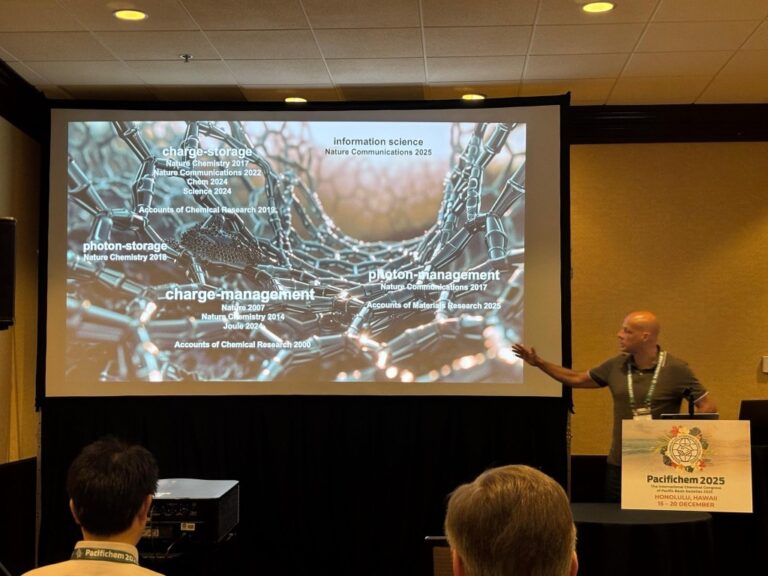
At the Pacifichem 2025 conference in Honolulu, Dirk Guldi, spokesperson of FAU Solar, showcased cutting-edge advances in carbon dot research, highlighting how these versatile nanomaterials are redefining the landscape of light-driven energy conversion and catalysis. Against the vibrant scientific backdrop of the world’s largest international chemistry meeting, Dirk Guldi delivered an invited lecture entitled “Carbon Dots in Action: Advancing from Dye-Sensitized Solar Cells to Photocatalysis.”
The presentation traced the evolution of carbon dots from emerging light harvesters in dye-sensitized solar cells to powerful functional components in photocatalytic architectures. By bridging fundamental photophysics with device-relevant applications, the lecture underscored the transformative potential of carbon dots for sustainable energy technologies and catalytic innovation.
Beyond the lecture hall, Pacifichem 2025 offered an exceptional forum for interdisciplinary exchange. The conference dinner provided a memorable setting for scientific dialogue and camaraderie among leaders in materials chemistry, nanoscience, and molecular electronics—further strengthening the global network that drives progress in this rapidly evolving field.